
What Buyers Are Really Doing With That Inspection Report 🔍
When a buyer orders a home inspection on a Long Island property, they've usually already decided to buy. What they're doing is building a case. Here's what Nassau and Suffolk County sellers need to know about how inspection reports are really used — and how to respond without giving away money you didn't need to.
Thomas Brady
3/24/20264 min read
What Buyers Are Really Doing With That Inspection Report 🔍
After more than 20 years in law enforcement, you learn to watch what people do, not just what they say. That skill translates directly to real estate — and nowhere is it more useful than when a home inspection report lands on the negotiating table.
Here's something most sellers in Nassau and Suffolk County never figure out until it's too late: when a buyer orders a home inspection, they're rarely doing it to decide whether to buy your house. By that point, they've already decided. What they're doing is building a case.
What a Home Inspection Report Actually Is 📋
A standard home inspection on a Long Island property produces a detailed written report — often 40 pages or more — covering everything from the roof to the foundation, electrical systems, plumbing, HVAC, windows, insulation, and dozens of other items. Inspectors are thorough by design. Their job is to document every observable condition, and they do.
What that means in practice is that virtually every home inspection report — on every home, regardless of condition or age — comes back with a long list of findings. Some are genuinely significant. Many are routine maintenance items. Some are simply observations about the age of components that are still functioning fine. An inspector noting that a water heater is ten years old isn't saying it needs to be replaced — but that notation is now in writing.
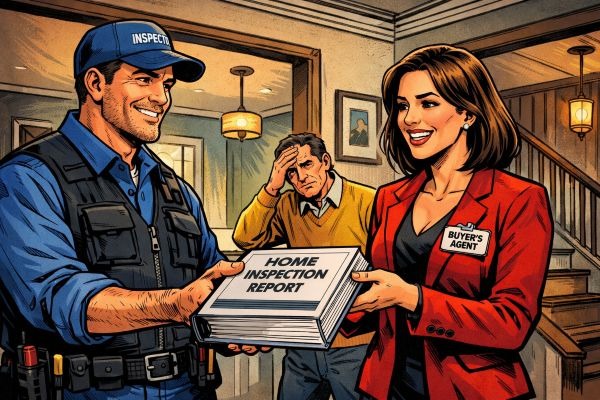
That report then goes to the buyer's agent. And that's where the strategy begins.
How Buyers Use the Inspection Report as Leverage ⚠️
A 40-page report full of findings — most of them minor, most of them standard for any home of that age — gets handed to the buyer's agent like a negotiating tool. Suddenly there's a request for a $15,000 credit. The seller panics, thinking the house is falling apart.
It isn't. But the panic is exactly what they're counting on.
This is a well-worn tactic in Nassau and Suffolk County real estate transactions. The buyer was emotionally committed to the home at the showing. The offer was already negotiated. Now the inspection report provides a second opportunity to renegotiate — often for items that were visible or known before the offer was ever made. The roof that has a few years left. The electrical panel that's older but fully functional. The aging but working HVAC system.
None of these are surprises. But presented together in a formal report, they can feel overwhelming to a seller who isn't prepared for them.
The Wrong Way to Respond — And Why It Costs You 💰
The wrong response is the emotional one. A seller who sees a $15,000 credit request and panics — either caving immediately or becoming so defensive that the deal falls apart — has let the tactic work exactly as intended.
Caving to an inflated credit request because the inspection report felt alarming means giving up money you didn't need to give up. Walking away from a deal over a negotiable item means starting over — new listing activity, more days on market, and often a lower final price the second time around. Neither outcome serves you.
The inspection period is not the end of the transaction. It's round two of the negotiation. Treating it that way — calmly and strategically — is what separates sellers who come out ahead from those who don't.
The Right Way to Respond 🤝
The right response starts well before the inspection report arrives. Sellers who know their home's condition going into the listing process are never caught off guard. They've already thought through which items are likely to come up, how significant they actually are, and what a reasonable response looks like.
When a credit request comes in, the right approach is to evaluate it item by item. What's genuinely warranted? What's inflated? What was already priced into the listing? A $15,000 credit request built on a list of minor maintenance items and aging-but-functional systems is not the same as a $15,000 request built on a failed roof or a cracked foundation. They require very different responses.
Sometimes the right answer is a partial credit on legitimate items and a firm rejection of the rest. Sometimes it's offering to address specific repairs rather than a blanket credit. Sometimes the right answer is to hold firm entirely. The key is knowing which situation you're in — and having the experience to make that call confidently.
What an Experienced Long Island Broker Does Differently 🏡
We've sat across the table from this move more times than we can count in Nassau and Suffolk County transactions. We know what a legitimate inspection concern looks like versus what's being used as a pressure tactic. We know when to push back and when a reasonable concession keeps a good deal intact.
More importantly, we prepare our sellers for this conversation before it happens. We walk through what's likely to come up in the inspection, how to think about each item, and what a reasonable response range looks like. By the time that report lands, nothing in it should surprise you — and you should already have a strategy for responding to it.
That preparation is the difference between giving away money you didn't need to give and protecting every dollar of your net proceeds.
The Bottom Line ✅
Every home inspection report is long. Every one of them has findings. That is not a crisis — it's the normal result of a thorough inspector doing their job. The question isn't whether the report will have items on it. The question is whether you'll be prepared to respond to them strategically when it does.
In the Nassau and Suffolk County market, where buyers are well-represented and experienced agents know exactly how to use an inspection report at the negotiating table, going in unprepared is a costly mistake. Know your home. Know what's coming. And have a broker in your corner who has seen this play before and knows exactly how to respond.
Ready to Talk Strategy Before You List? 📞
We'd love to sit down with you before your home hits the market and walk through exactly what to expect — including how to handle the inspection negotiation when it comes. No pressure, no obligation. Just the kind of preparation that protects your bottom line.
Thomas Brady SFR, e-PRO, SRES, BPOR, C-REPS Licensed Associate Real Estate Broker / Director of Operations Notary Public | Retired N.Y.P.D. Lt. | U.S. Air Force Veteran 🇺🇸
Vintage American Realty LLC 1551 Montauk Hwy, Suite E • Oakdale, NY 11769 📞 631-682-8660 ✉️ TomBradyHomes@Gmail.com 🌐 VintageAmericanRealty.com
Vintage American Realty, LLC
Vintage American Realty, LLC is licensed in the State of New York
broker: 631.816.0719
info@vintageamericanrealty.com
1551 Montauk Hwy, Ste E
Oakdale, NY 11769
Long Island, NY